


| Quantity: | |
|---|---|
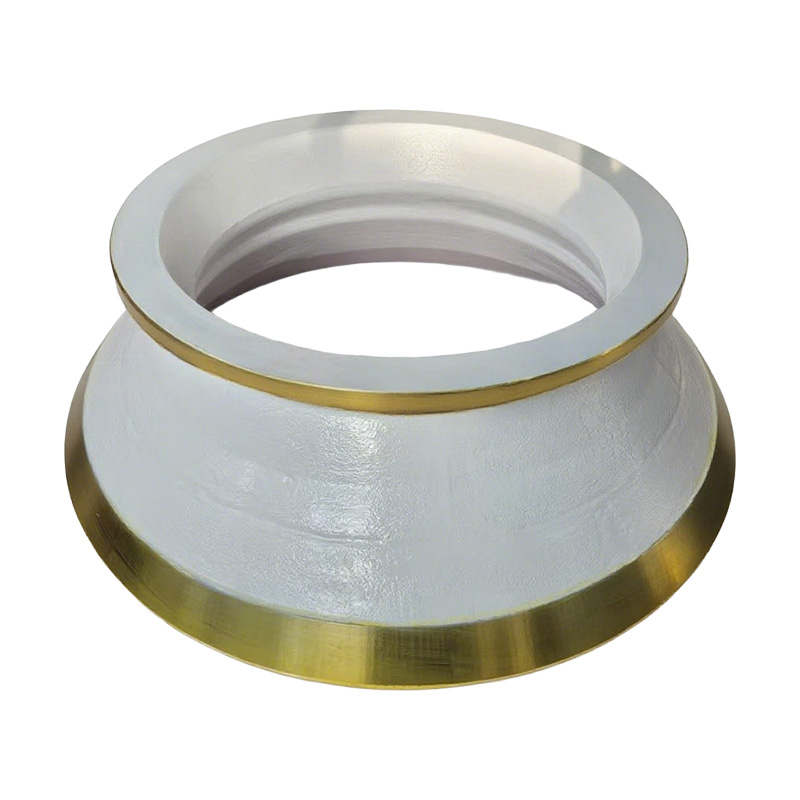
Mantles and concave are the core matched wear components of cone crushers, forming the core crushing cavity for secondary and tertiary fine crushing circuits. The mantle is fastened to the eccentric main shaft and performs continuous gyratory swing motion. Driven by the eccentric mechanism, it generates cyclic compression, shear and rolling force on ores inside the cavity. The concave liner is fixed on the upper frame of the cone crusher. Together with the swinging mantle, it forms a complete tapered crushing chamber. After raw materials enter the chamber, they are repeatedly squeezed, bent and sheared until broken down to the required particle size, then discharged through the bottom gap. This structural advantage makes cone crushers widely used for medium and fine crushing of medium-to-high hardness ores such as granite, basalt, iron ore, copper ore and limestone.
This set of liners serves critical production lines across mining, aggregate quarrying, cement manufacturing, metallurgy and construction waste recycling. Their metallurgical quality, structural integrity and service life directly determine the whole line’s crushing efficiency, finished particle shape, hourly throughput and comprehensive operation cost. Our mantles and concaves adopt mature modified manganese steel series materials including Mn13 and Mn18Cr2 as the base raw material. High manganese steel boasts prominent work-hardening properties: under continuous heavy impact and extrusion, the liner surface rapidly strengthens while the internal matrix maintains good toughness, effectively avoiding brittle cracking. For ultra-high abrasion working conditions, we also provide customized high-chromium alloy liners with stronger wear resistance. The dual material system extends component service cycles and cuts unplanned downtime caused by frequent wear part replacement.
All liners are produced with exclusive composite smelting and segmented tempering processes. Compared with ordinary standard manganese steel liners on the market, their overall service life is lifted by 10%–15%. Even under long-term continuous crushing of hard rocks like granite and basalt, the matrix can maintain stable structural rigidity and resist permanent plastic deformation. For mines with high quartz content and severe abrasion, high-chromium alloy options can further double wear resistance.
We adopt integrated lost foam casting technology to completely eliminate casting flash, burrs, internal pores and shrinkage cavities. The finished dimensional tolerance is controlled within ±0.5 mm. High matching precision guarantees seamless assembly with mainstream cone crusher brands including Sandvik, Terex and Metso, eliminating assembly gaps, eccentric vibration and material leakage after installation.
Our composite wear-resistant materials greatly reduce replacement frequency. Calculated based on full-cycle spare part expenditure, maintenance labor and downtime losses, customers can achieve up to 30% higher economic return compared with ordinary liners. For large-scale concentrators and aggregate plants with 24-hour continuous production, the benefit of reducing shutdown frequency becomes more prominent.
We design three mainstream cavity structures: standard, medium and short-head crushing profiles to adapt to different feed sizes, crushing ratios and throughput targets. The streamlined curved cavity surface optimizes ore flow tracks, shortens material residence time inside the machine and produces more cubic finished aggregates with less needle-shaped fragments. Partial liner models adopt split modular structures, which greatly simplify disassembly, inspection and daily maintenance work on site. Meanwhile, precise machining avoids unilateral eccentric wear caused by poor fitting, protecting the main shaft and frame from secondary damage.
| Parameter Item | Standard Specification |
|---|---|
| Main Raw Material | Modified high manganese steel composite; high-chromium alloy for customized orders |
| Forming Process | Lost foam precision casting |
| Compatible Equipment | Sandvik, Terex, Metso and other mainstream cone crusher brands |
| Adaptable Ore Hardness | Compressive strength ≤350 MPa (granite, basalt, iron ore, copper ore, limestone etc.) |
| Customization Service | Fully customized according to customer drawings, physical samples and crusher model parameters |
| Surface Quality Standard | Burr-free, no flying edges, compact internal metallurgical structure without pores |
Metal Mining Circuits Widely used for secondary and tertiary crushing of iron ore, copper ore and gold ore. After coarse crushing, raw ores enter cone crushers fitted with our liners to reach the qualified feeding fineness for grinding and flotation. The material formula is optimized for hard, highly abrasive underground mine ores to stabilize long-term continuous operation.
Aggregate Quarry Production Lines Process granite, basalt and limestone into qualified construction aggregates for commercial concrete and asphalt pavement. Optimized cavity design ensures uniform particle grading and excellent cubic grain shape, meeting strict highway and building material standards.
Cement Raw Material Crushing Specialized limestone and clay crushing solutions support stable kiln feeding granularity for cement plants, adapting to large-throughput continuous production requirements.
Construction Waste Recycling Industry Crush waste concrete, bricks and stone blocks into renewable recycled aggregates, realizing circular economy and lowering raw material procurement costs for building material factories.
Metallurgical & Chemical Raw Material Processing Complete medium and fine crushing of various high-hardness industrial raw materials, providing stable particle size products for subsequent smelting and chemical processing links.
The actual service life of mantles and concaves is not fixed; it is jointly determined by feed hardness, feed particle composition, crusher model and daily operating parameters. Four key measures can effectively extend liner service cycles: select matched material grade and cavity profile based on ore abrasion index, keep uniform feeding to avoid local overload, reasonably adjust the discharge gap to reduce over-compression wear, and arrange regular wear inspection. Timely replacement before excessive thinning can prevent broken liner fragments from entering the crushing chamber and causing permanent damage to the main machine.
As the core functional components that determine cone crusher output and product quality, mantles and concaves are irreplaceable in mineral processing and aggregate production. Reliable metallurgical formula, precision lost foam casting and targeted cavity design work together to deliver long-term stable and high-efficiency crushing performance. Proper matching liners can significantly boost hourly throughput, cut maintenance labor and spare part expenditure, and create lasting economic profits for mines, quarries and cement enterprises.
We develop matched liner sets covering most mainstream international brands such as Sandvik, Terex and Metso. Customers only need to provide the complete crusher model, or supply physical samples and technical drawings, and we can customize fully matching wear parts.
Lost foam casting realizes full-mold filling under negative pressure, effectively avoiding air entrapment, surface pits and internal shrinkage defects common in traditional sand casting. The internal metallurgical structure is far denser, lifting overall impact resistance by 25% and largely eliminating early cracking and abnormal wear failures in service.


