Views: 0 Author: Site Editor Publish Time: 2026-10-05 Origin: Site
Abrasive quarry rock takes a severe mechanical toll on crushing equipment daily. Consumable wear components dictate your operational uptime and plant profitability. Rapid degradation of standard liners leads to unplanned downtime, inconsistent aggregate gradation, and an inflated cost-per-ton. We must separate mechanical spare parts—like bearings, eccentric shafts, and drive belts—from consumable crusher wear parts. Items like jaw dies, mantles, and blow bars naturally degrade during material reduction and require strategic replacement cycles. Selecting the correct metallurgy, profile, and fitment for your quarry crusher wear parts is a strict engineering decision. This choice directly controls plant throughput capacity and product quality.
Matching wear part metallurgy (e.g., manganese percentage, chrome alloys, ceramic inserts) to specific quarry stone geology (silica content, compressive strength) is critical for maximizing service life.
Different crushing stages demand distinct solutions: work-hardening alloys for high-impact primary crushing, and highly abrasion-resistant materials for secondary/tertiary shaping.
Evaluating a crusher wear parts manufacturer requires prioritizing foundry quality control, heat treatment consistency, and dimensional accuracy over initial purchase price.
Silica content and the Bond Work Index define how rock breaks and how it destroys metal inside a crushing chamber. Common quarry stones like basalt, granite, and quartzite possess exceptionally high compressive strength. They act much differently than softer sedimentary rocks like limestone. Virgin quarry rock extraction contrasts sharply with recycling applications like concrete or asphalt crushing. Natural quarry stone demands significantly higher impact and abrasion resistance from quarry crushing wear parts. High-abrasion rock accelerates micro-gouging. It rapidly degrades standard metal surfaces, forcing frequent change-outs and disrupting production schedules.
When processing high-silica materials, the friction generated during the reduction process acts like a grinding wheel against the steel castings. This continuous abrasive action strips away the protective layers of the metal. If the compressive strength of the rock exceeds the yield strength of the wear part material, you will experience rapid deformation and premature failure. Operators must analyze core samples from the quarry face to determine the exact abrasion index before ordering replacement liners. You cannot guess the geology; you need hard data from Los Angeles Abrasion tests to make informed metallurgical choices.
You need clear baseline evaluation metrics to judge the performance of your liners. Track the cost per ton processed meticulously. Measure the total hours of operational life for every casting installed. Monitor the maintenance of the closed-side setting (CSS) daily. Holding a consistent CSS ensures reliable product gradation and minimizes the recirculating load. When a wear part loses its profile too quickly, the CSS widens prematurely. This forces oversized material into the secondary circuit, bottlenecking the entire plant and wasting massive amounts of electrical energy.
Effective wear part management relies on predictable wear rates. If a jaw plate lasts 400 hours during one cycle and only 250 hours the next, you cannot accurately plan maintenance shutdowns. Consistency in casting quality directly translates to consistency in plant output. You must establish a historical baseline of wear data to evaluate whether upgrading to a premium alloy actually delivers a tangible return on investment. Without tracking tonnage and hours, any change in liner material is just a blind guess.
Rock Type | Silica Content (%) | Compressive Strength (MPa) | Abrasiveness Level |
|---|---|---|---|
Limestone | 1 - 5 | 50 - 100 | Low |
Granite | 65 - 75 | 130 - 250 | High |
Basalt | 45 - 55 | 150 - 300 | Very High |
Quartzite | 90 - 98 | 150 - 350 | Extreme |
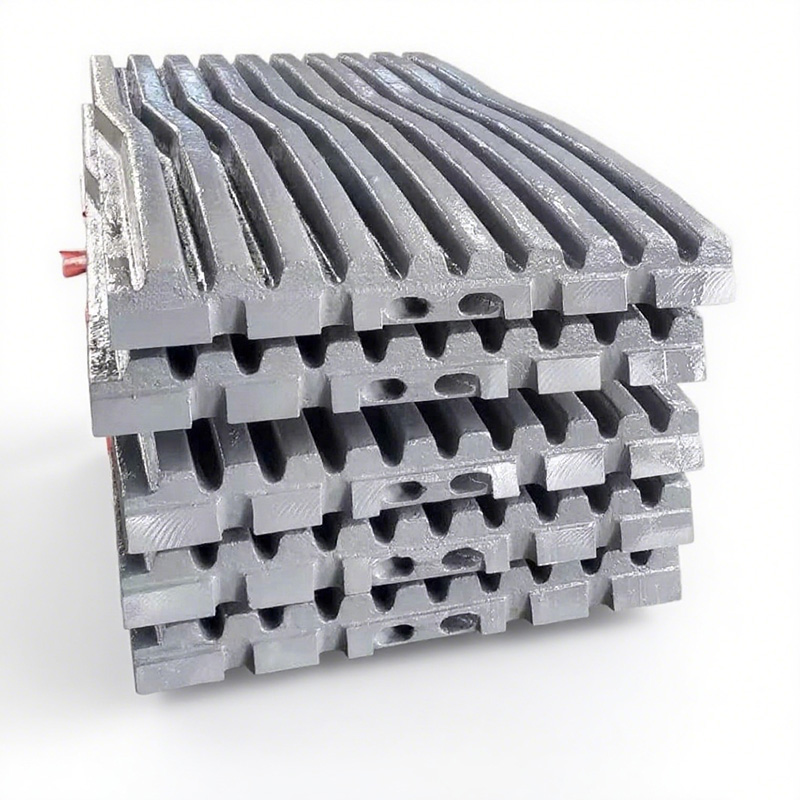
The primary jaw crusher dictates the entire plant's throughput capacity. Premature wear here creates a massive bottleneck. It halts all downstream production and starves your secondary crushers. You must select the right jaw crusher wear parts for your specific rock geology. Profiling options include corrugated, flat, heavy-duty, and sharp tooth designs. Match the profile to feed size, rock hardness, and desired slab reduction. A corrugated profile works exceptionally well for gripping round river rock, while a heavy-duty flat profile provides maximum wear metal for highly abrasive, blocky granite.
Austenitic manganese steel plays a massive role in primary crushing. Foundries typically cast these plates in 14%, 18%, or 22% manganese grades. This material features unique work-hardening properties under heavy primary compression. The repeated, violent impact of large boulders hardens the outer layer of the jaw plate. Meanwhile, the core of the casting remains ductile and tough. This ductility prevents the plate from shattering under extreme stress. Choosing the right manganese percentage depends entirely on the impact force generated by your specific feed material. If you run soft limestone, 14% manganese is sufficient. If you blast hard quartzite, you need 18% or 22% to handle the extreme impact forces.
Cheek plates protect the crusher frame from lateral abrasion. As rock crushes between the jaw dies, it also grinds against the sides of the chamber. Hardened steel armor plating shields the internal structural integrity of the machine from this constant friction. If you neglect cheek plate wear, the rock will eventually gouge the main frame. Repairing a gouged main frame requires extensive welding, line boring, and weeks of downtime.
The toggle plate acts as a critical safety mechanism. Think of it as a mechanical fuse for your primary crusher. It is designed to fail during uncrushable events, like an excavator tooth or tramp iron entering the chamber. When the pressure exceeds safe limits, the toggle plate snaps or bends. This intentional failure immediately drops the movable jaw, opening the chamber and protecting the eccentric shaft and expensive pitman bearings from total destruction. Never replace a factory toggle plate with a piece of scrap steel; you will destroy your crusher the next time tramp iron enters the feed.
Chamber profile selection is vital for maximizing cone crusher efficiency. You can choose coarse, medium, fine, or extra-fine profiles. Match this profile precisely to the specific feed gradation coming from your primary circuit and your desired reduction ratio. The mantle and concave work together to form the crushing chamber. As the mantle orbits, it pinches the rock against the concave. Selecting the wrong profile for your feed size results in poor crushing geometry, excessive recirculating loads, and wasted energy. If the feed is too small for a coarse chamber, the rock will fall too far down before being crushed, causing severe wear at the very bottom of the liners.
Common wear patterns in cone crusher wear parts include bell-mouthing and cupping. These patterns indicate premature localized wear. Improper feed distribution often causes this issue. If material segregates and drops heavily on one side of the chamber, that side will wear out rapidly. Ensure consistent choke feeding to maintain a uniform wear profile. Choke feeding keeps the chamber full, promoting rock-on-rock crushing. This reduces the direct abrasion on the manganese liners and significantly extends their service life. Operators must monitor the surge bin levels and adjust the variable frequency drive (VFD) on the pan feeder to keep the cone head buried in rock.
Standard manganese sometimes falls short in extreme hard-rock quarry environments. When processing highly abrasive quartzite or basalt, operators must evaluate the return on investment for material upgrades. Titanium Carbide (TiC) inserts offer a massive leap in durability. Foundries cast these hard ceramic columns directly into the high-wear zones of the manganese matrix. As the softer manganese wears away, the ultra-hard TiC columns are exposed, taking the brunt of the abrasive sliding action.
Specialized alloy matrices extend mantle life significantly. They resist the intense sliding abrasion found in secondary and tertiary crushing stages. While these premium parts require a higher initial outlay, they often double or triple the operational lifespan of the liner. This drastically reduces maintenance downtime and lowers the overall cost per ton in severe applications. You spend less time pulling the crusher apart and more time making saleable aggregate.
Impact crushers produce excellent cubical aggregate shape but suffer notoriously high wear rates. The rotor spins at high speeds, smashing the blow bars into the incoming rock. You must compare high-chrome, martensitic steel, and manganese blow bars carefully. You face strict trade-offs between impact resistance and abrasion resistance. High-chrome offers incredible abrasion resistance but is highly brittle. It will shatter if large, uncrushable material enters the chamber. You should only use high-chrome in secondary or tertiary applications where the feed size is strictly controlled.
Martensitic steel provides a reliable middle ground. It offers better impact resistance than chrome and better abrasion resistance than standard manganese. Assess the viability of ceramic-inserted blow bars. They excel at extending lifespan in highly abrasive, low-impact tertiary applications. Selecting the right impact crusher wear parts requires analyzing feed size, rock hardness, and the specific rotor speed of your machine. Running the rotor too fast with the wrong blow bar material will result in catastrophic failure.
Maintaining rotor balance is an absolute necessity in impact crushing. If blow bars wear unevenly, the resulting vibration will destroy the rotor bearings in a matter of hours. You must weigh replacement blow bars and install them in matched sets across the rotor. Precise crushing chamber geometry ensures a consistent, cubical aggregate shape. The rock must strike the breaker plates at specific angles to fracture correctly along its natural cleavage lines.
Uneven wear on breaker plates disrupts the material flow. It forces the crusher to work harder and reduces the quality of the final product. You must inspect the internal apron liners and breaker plates during every maintenance shift. Replacing these wear plates before they completely degrade protects the crusher housing and maintains the optimal reduction ratio. Once the rock wears through the liner and hits the outer steel housing, you are facing a massive fabrication repair job.
Work-hardening is a fascinating mechanical process. Impact forces cause the crystal structure of manganese steel to compress and harden on the surface. The phase transformation changes the outer layer from soft austenite to hard martensite. This explains why it excels in high-impact environments like jaw and cone crushers. The heavy crushing forces continually renew the hardened outer layer as it wears away, while the core remains ductile enough to absorb shock without snapping.
However, manganese underperforms in low-impact, high-abrasion scenarios. Without heavy impact, the surface never hardens. The soft underlying metal simply wears away rapidly under sliding abrasion. Using manganese blow bars in a tertiary impact crusher processing small, abrasive gravel will result in extremely short wear life. The rock will scour the metal away before it ever has a chance to work-harden.
High-chrome white iron delivers superior abrasion resistance. The high chromium content forms hard carbides within the iron matrix. It thrives in secondary and tertiary impact crushers where the feed size is small and the primary wear mechanism is pure abrasion. It maintains its profile exceptionally well, ensuring consistent aggregate shape over a long period. Operators love high-chrome for making manufactured sand because it holds a sharp edge.
However, you must evaluate the catastrophic failure risks. High-chrome is inherently brittle. It will shatter if used inappropriately in primary crushing with large feed sizes. A single piece of tramp metal or an oversized boulder can snap a high-chrome blow bar in half, causing massive internal damage to the crusher rotor, apron plates, and housing.
Hardened steel armor plating works strategically for high-wear zones. These zones require longevity but not the full impact resistance of manganese. You will often see AR (Abrasion Resistant) steel plates lining feed chutes, discharge hoppers, and crusher main frames. AR400 and AR500 plates are standard in the industry for protecting static structures from sliding rock.
Premium composites, like metal matrix composites, offer immense value. Foundries combine tough steel alloys with ultra-hard ceramic inserts. Analyze the cost-benefit ratio for high-throughput quarry stone production. When downtime costs exceed part premiums, investing in advanced composites makes perfect operational sense. They provide the toughness to survive impact and the hardness to resist severe abrasion.
Alloy Type | Best Application | Impact Resistance | Abrasion Resistance |
|---|---|---|---|
Austenitic Manganese (14%-22%) | Primary Jaw & Cone Crushers | Very High | Moderate |
High-Chrome White Iron | Tertiary Impact Crushers | Low | Very High |
Martensitic Steel | Secondary Impact Crushers | Moderate | High |
Ceramic Inserts (TiC) | Hard Rock Cone & Impact | Moderate | Extreme |
Partnering with a reliable crusher wear parts manufacturer changes your operational efficiency. Controlled heat treatment is non-negotiable. If a foundry cuts corners during the quenching process, the manganese will remain brittle and prone to cracking. Precise pouring temperatures dictate the final grain structure of the metal. A poor pour results in a weak casting that will fail under the immense pressure of a primary crusher.
Rigorous non-destructive testing ensures part integrity. Look for manufacturers that utilize ultrasonic testing, magnetic particle inspection, and dye penetrant testing. These tests reveal internal voids, shrinkage, or micro-cracks before the part ever reaches your site. Installing a defective casting can lead to mid-shift failures that cost thousands of dollars in lost production and emergency crane rentals.
Poor machining tolerances cause massive headaches during installation. They lead to backing compound failures. Localized stress concentrations develop when parts do not seat perfectly against the crusher frame. This inevitably causes premature part failure. The crushing forces must transfer evenly through the wear part and into the machine structure. If there is a gap, the casting will flex and eventually crack.
Precision fitment ensures the crushing forces distribute evenly across the mantle or jaw plate. If a cone crusher mantle rocks or shifts on the head because of poor machining, the epoxy backing will crack. Once the backing fails, the mantle will stretch, deform, and eventually split open during operation. You will then spend hours torching the ruined mantle off the head.
Weigh the reliability of proprietary OEM designs. They guarantee a baseline fit and predictable performance. However, specialized aftermarket foundries often provide superior flexibility and engineering support. They offer custom alloy profiles tailored to specific quarry conditions. You are not locked into a generic catalog part.
If your rock is exceptionally abrasive, a custom aftermarket casting might outperform the standard OEM manganese. Aftermarket manufacturers can modify the crushing chamber profile, add thicker wear metal in high-wear zones, or integrate ceramic inserts. Evaluate aftermarket suppliers based on their engineering capabilities, metallurgical transparency, and track record in similar geological conditions.
Implement actionable strategies to extend part life. Track wear profiles weekly using ultrasonic thickness gauges. Rotate jaw plates at optimal intervals to maximize metal utilization. Most jaw plates wear heavily at the bottom (the discharge zone). Flipping the plate halfway through its life ensures you use all the available wear metal. Do not wait until the corrugations are completely flat to flip the die, or you will lose your gripping ability.
Maintain consistent choke feeding in cone crushers. This practice ensures even wear across the entire crushing chamber. Uneven feeding creates localized wear pockets and ruins the liner prematurely. Install surge bins and variable speed feeders to ensure a steady, continuous flow of material into the crushing chamber. Keep the rock box full so the material falls dead-center onto the mantle.
Downtime planning is a critical management task. Enforce strict heavy lifting safety protocols. Replacing massive steel castings carries inherent physical risks. Ensure all lifting lugs are inspected and rigging equipment is rated for the correct tonnage. Never stand under a suspended mantle or jaw die.
Pay close attention to the application and curing of backing materials like epoxy. Improperly cured backing compound allows the liner to shift. Temperature control is vital during the pouring process. If the ambient temperature is too cold, the epoxy will not cure correctly. This movement destroys the crusher frame and the new wear part. Follow the manufacturer's exact specifications for mixing and pouring backing compounds.
Clean the crusher head and bowl thoroughly, removing all old backing material and grease.
Apply a release agent to the crusher head to ensure the mantle can be removed easily during the next change-out.
Seat the new liner and tighten the locking nut or wedge bolts to the specified torque.
Mix the epoxy backing compound only when the ambient temperature is within the manufacturer's acceptable range.
Pour the backing compound evenly, ensuring no air pockets form behind the liner.
Allow the compound to cure completely before starting the crusher or feeding rock.
Conduct a comprehensive wear audit of your current parts, documenting the exact hours and tonnage achieved by your last set of liners.
Calculate the existing cost-per-ton for your primary and secondary circuits to establish a strict performance baseline.
Request specific alloy recommendations from your foundry partner based on recent Los Angeles Abrasion test results and Bond Work Index data.
Standardize your inspection intervals and train operators to measure the closed-side setting (CSS) daily to catch premature wear early.
A: Wear parts, like jaw plates and blow bars, are consumable components designed to directly contact and crush rock. They naturally degrade and require regular replacement. Mechanical spare parts, such as bearings, shafts, and drive belts, support the machine's operation but do not directly crush the material.
A: Austenitic manganese steel is the optimal choice for primary jaw crushing in granite. Granite has high compressive strength, providing the heavy impact necessary to work-harden the manganese. An 18% or 22% manganese alloy offers excellent durability and impact resistance for this abrasive rock.
A: Replacement intervals vary heavily based on rock abrasiveness and feed size. In hard rock applications like quartzite, mantles and bowl liners may need replacement every 300 to 600 hours. Regular inspections and tracking the closed-side setting (CSS) will dictate the exact replacement schedule.
A: No, high-chrome blow bars are highly brittle. Using them in primary crushing with large feed sizes introduces a severe risk of catastrophic shattering. They are strictly designed for secondary or tertiary applications where feed sizes are smaller and abrasion resistance is the primary requirement.
A: Trickle feeding, improper feed distribution, and operating outside the recommended reduction ratio cause premature wear. In cone crushers, failing to maintain a choke-fed chamber leads to localized wear patterns like cupping. Uncrushable tramp metal also causes immediate and severe damage to wear surfaces.
A: Dimensional accuracy ensures the wear part seats perfectly against the crusher frame. Poor machining tolerances create gaps, leading to backing compound failure and localized stress concentrations. This uneven stress distribution frequently causes the casting to crack or fail prematurely under heavy crushing loads.